

SAFETEC SOLUTIONS LTD | Approved EHS Consultants in Kenya
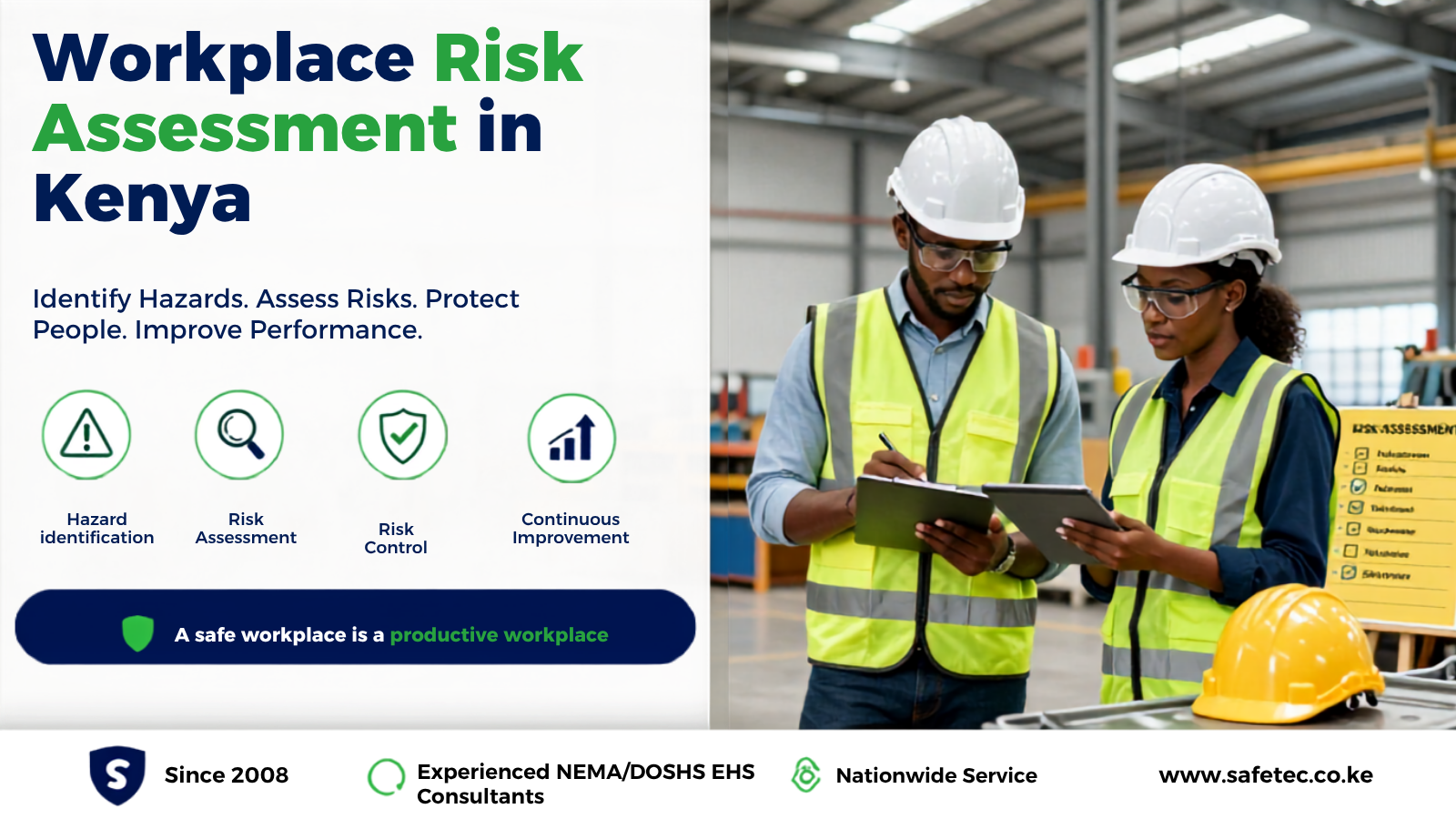
Workplace Risk Assessment in Kenya | Safetec solutions
Workplace Risk
Assessment in Kenya: A Complete Guide for Employers in 2026
Introduction
Every workplace has
hazards, but not every workplace manages them effectively. Whether you operate
a manufacturing plant, construction site, hospital, warehouse, office, school,
or commercial facility, identifying and controlling workplace hazards is essential
for protecting employees, maintaining productivity, and complying with
occupational safety requirements.
A workplace risk
assessment is one of the most effective and useful tools for preventing
accidents before they occur. It helps employers identify hazards early,
evaluate the level of risk, and implement practical/control measures to protect
workers, visitors, contractors, and the surrounding environment.
At Safetec Solutions Limited, we have been helping organizations across Kenya improve
workplace safety since 2008. Our experienced Environment, Health and
Safety (EHS) consultants conduct professional workplace risk assessments,
Safety trainings together with Environmental, OSH and fire risk assessment
audits for NEMA and DOSH compliance and advisory; tailored to different
industries, helping businesses strengthen compliance, reduce operational risks,
and build safer working environments.
What is a
Workplace Risk Assessment?
A workplace risk
assessment is a structured process of identifying hazards, evaluating the risks
they present, and implementing suitable and practical control measures to
eliminate or reduce those risks.
Rather than reacting
after an accident has occurred, organizations take a proactive approach by
identifying potential dangers before they cause injuries, illnesses, equipment
damage, or financial losses through internal Safety and health audits focused
on hazard identification and risk assessments.
Risk assessments
form an essential part of an effective Occupational Safety and Health (OSH)
management system and support continuous improvement in workplace safety and
regulatory compliance.
Why Workplace
Risk Assessments Matter
Many workplace
incidents can be prevented through proper planning and hazard identification. A
professional risk assessment helps organizations understand where hazards exist
and prioritize actions that protect employees and business operations. This
also helps organizations identify the blind spots in the workplace and mitigate
risks associated early before they cause accidents.
The benefits
include:
- Reduced workplace injuries and
occupational illnesses
- Improved employee confidence and
morale
- Better compliance with DOSHS and
NEMA requirements
- Lower insurance and compensation
costs
- Reduced equipment downtime
- Improved productivity
- Enhanced business reputation
- Better preparedness for workplace
inspections and audits
- Reduced employee turn-over
Investing in
prevention is often significantly more cost-effective than responding to
workplace accidents after they occur. Prevention of accidents occurrence is
better that treating injuries.
Who Needs a
Workplace Risk Assessment?
Every organization
can benefit from a workplace risk assessment, regardless of size or industry.
Common sectors
include:
- Manufacturing industries
- Construction companies
- Educational institutions
- Hospitals and healthcare
facilities
- Warehouses and logistics
companies
- Hotels and hospitality businesses
- Offices and commercial buildings
- Agricultural enterprises
- Retail businesses
- Government institutions
- NGOs and development
organizations
If your workplace
has employees, machinery, chemicals, electrical systems, vehicles, or public
access, a risk assessment is an important tool of managing workplace safety.
Common Workplace
Hazards in Kenya
Physical Hazards
Physical hazards are
among the most common causes of workplace injuries.
These are majorly
caused by coming into physical contact with matter.
Examples include:
- Slippery floors
- Working at height
- Poor housekeeping
- Falling objects
- Noise
- Excessive vibration
- Extreme temperatures
- Sharp objects
Chemical Hazards
Many workplaces use
substances that can affect employee health if not handled properly.
Most commonly in
manufacturing, healthcare, laboratories, agricultural sectors.
Examples include:
- Cleaning chemicals
- Industrial solvents
- Paints
- Welding fumes
- Dust
- Laboratory chemicals
Biological Hazards
Healthcare
facilities, laboratories, agricultural operations, and food industries may
expose workers to biological risks such as bacteria, viruses, fungi, or
contaminated materials.
This affects the whole health of
employees; it is a major reason to give priority to risk assessments to
identify the hazards workers are exposed to .
Ergonomic Hazards
Poor workstation
design and repetitive work can lead to musculoskeletal disorders.
Examples include:
- Poor lifting techniques
- Repetitive motions
- Prolonged sitting
- Awkward postures
- Poor workstation layout
- Prolonged standing
- Longer working hours
This calls for employers to tailor the
jobs to fit the employee for optimum results or rather productivity.
Fire Hazards
Fire remains one of
the most serious workplace risks.
Common causes
include:
- Faulty electrical installations
- Improper storage of flammable
materials
- Gas leaks
- Poor housekeeping
- Blocked emergency exits
- Ignorance of SOPs
- Arson
- Naked/exposed electrical wires
- Overloaded sockets
At Safetec solutions limited, our area
of expertise includes fire safety auditing through our competent and
experienced team of auditors; We help you identify the fire risks at your
workplace, evaluate the effectiveness of the control measures in place and also
advice on the strategy to implement a full functional workplace fire safety
management system.
Electrical Hazards
These are hazards that
are as a result of electrical faults and use of electrical power in the
workplace.
Examples include:
- Exposed wiring
- Damaged equipment
- Improper grounding
- Overloaded sockets
- Unsafe maintenance practices
The Workplace
Risk Assessment Process
Professional
workplace risk assessments generally follow five key stages.
Step 1: Identify
Hazards
Safety consultants
inspect the workplace to identify hazards that may cause injury, illness, or
damage.
This includes site
inspections, interviews, document reviews, and observation of work activities
through walk through surveys.
Step 2: Assess the
Risks
Each hazard is
evaluated based on:
- Likelihood of occurrence
- Potential severity
- Number of people exposed
- Effectiveness of existing control
measures
- Duration of exposure
This helps determine
which risks require immediate attention.
Our team gives you a clear, simple and
well oriented corrective action plan after a risk assessment has been done.
Step 3: Recommend
Control Measures
Suitable control
measures are identified using the hierarchy of controls, including:
- Elimination
- Substitution
- Engineering controls
- Administrative controls
- Personal Protective Equipment
(PPE)
Here, the utmost goal is to ensure the
workers, visitors and contractors are safe during and after work. Reduce
injuries, illnesses and therefore increasing productivity.
Step 4: Document the
Findings
A comprehensive
report is prepared detailing:
- Identified hazards
- Risk ratings
- Recommended corrective actions
- Responsible persons
- Implementation timelines and;
- Status of completion/closure
This documentation
supports ongoing safety management and demonstrates due diligence.
Step 5: Review and
Monitor
Risk assessments
should be reviewed whenever:
- New equipment is introduced
- Processes change
- Incidents occur
- New hazards emerge
- Workplace layouts are modified
On top of this,
risks can also be reviewed when a new employee is introduced in the team.Regular
reviews help ensure that control measures remain effective.
Signs Your
Organization Needs a Risk Assessment
Consider arranging a
professional workplace risk assessment with Safetec in Kenya if:
- You have recently expanded your
operations.
- New machinery or equipment has
been installed.
- Employees have reported unsafe
conditions.
- There have been near misses or
workplace incidents.
- You are introducing new chemicals
or processes.
- Your safety procedures have not
been reviewed for several years.
- You are preparing for an
Occupational Safety and Health (OSH) audit.
- You want to improve your overall
safety performance.
- You want to stay compliant to DOSHS
regulations in Kenya.
Workplace Risk
Assessment vs. OSH Audit
Many people confuse
workplace risk assessments with OSH audits in Kenya. While both contribute to
safer workplaces, they serve different purposes.
|
Workplace Risk Assessment
|
OSH Audit |
|
Identifies hazards and evaluates
risks |
Reviews the effectiveness of the
overall safety management system |
|
Conducted before hazards result in
incidents |
Evaluates existing policies,
procedures, and controls |
|
Focuses on preventing incidents |
Focuses on compliance and system
performance
|
|
Produces risk control
recommendations
|
Produces audit findings and
improvement recommendations
|
Why Choose
Safetec Solutions Limited?
Since 2008,
Safetec Solutions Limited has partnered with organizations across Kenya to
create safer, healthier, and more compliant workplaces.
Our experienced EHS
consultants provide:
- Workplace Risk Assessments
- Occupational Safety and Health (OSH:
DOSH compliant) Audits
- Workplace Inspections
- Fire Safety Audits
- Occupational Safety Training
- Fire Safety Training
- Environmental Compliance Advisory
- Industrial Hygiene Services
- Safety Management Consultancy
We work with
businesses across multiple sectors, providing practical recommendations
tailored to each client's operations and regulatory obligations.
From Learning
institutions, healthcare facilities, enterprise businesses ,commercial
buildings, laboratories, construction companies, warehouses and logistics to
manufacturing industries.
Frequently Asked
Questions
How often should a
workplace risk assessment be conducted?
Risk assessments
should be reviewed whenever significant changes occur in the workplace, such as
new equipment, processes, or incidents. Regular periodic reviews are also
recommended to ensure control measures remain effective. Our team can offer you
an internal risk assessment and statutory risk assessment done annually for
compliance.
Can small businesses
benefit from workplace risk assessments?
Yes. Every
workplace, regardless of size, can have hazards. A risk assessment helps small
businesses identify and manage risks before they result in injuries or
disruptions. This helps them to reduce compensation costs in case of accidents
and injuries hence increasing productivity.
What documents are
produced after a risk assessment?
A professional
assessment typically includes a report outlining identified hazards, risk
ratings, recommended control measures, responsible persons, and suggested
implementation timelines. This information can also be produced in a corrective
action plan.
What industries
require workplace risk assessments?
Risk assessments are
valuable across many sectors, including manufacturing, construction,
healthcare, education, logistics, hospitality, retail, agriculture, and office
environments.
Protect Your
Workforce with Professional Risk Assessment Services
Creating a safe
workplace is not just about meeting regulatory expectations; it is about
protecting your people, strengthening your operations, and building a resilient
organization.
At Safetec
Solutions Limited, our experienced consultants help organizations identify
workplace hazards, assess operational risks, and implement practical solutions
that support long-term safety and compliance.
Whether you manage a
factory, construction site, school, office, hospital, warehouse, or commercial
facility, we are ready to support your workplace safety goals.
Contact Safetec Solutions Limited today to schedule a professional Workplace Risk Assessment
and take a proactive step toward a safer, healthier, and more productive
workplace.